Dogs

Dogs

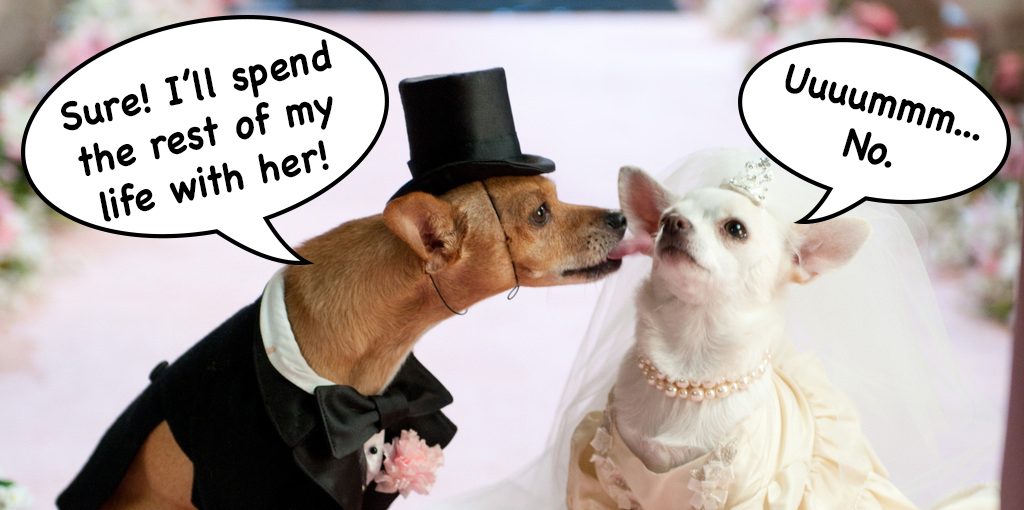
Meet and Greets: Don’t Force Your Dog Into An Arranged Marriage

Why are meet and greets so essential? If you follow our Facebook Page, you’ve presumably seen our dog posts. We write a short biography on each dog to give potential adopters an idea of an individual dog’s personality. You’ve also probably read numerous times that a dog “has potential with other dogs, though a meet and greet with your current dog(s) prior to adopting is highly recommended.” We feel like we write that over and over! But at a lot of shelters a meet and greet is not required to adopt, so we can’t force people to do it. However, if the option is there we would think every potential adopter would want to take advantage of it. Why wouldn’t someone want their dog to meet their potential new dog before bringing them home? Well, a lot of humans seem to think that dogs are different from us in that dogs should love everyone and everything and never dislike a person or dog they meet. While this might be the case for some dogs, it shouldn’t be assumed for all dogs. Just like humans don’t like every person they meet, dogs should not be expected to like every dog they meet. Certain personalities just don’t mesh. So when you hear that a dog up for adoption is good with other dogs, that shouldn’t make you think that a meet and greet is not necessary.  Potential adopters also should not think- “Ooooohh this dog is so sweet, no way she couldn’t like other dogs!” There are tons of dogs out there in the world that are loving, friendly, and cuddly until another dog comes around and suddenly they’re foaming at the mouth! We’ve met a lot of sweethearts during our time working in animal welfare, and this happens a lot. People friendly does not equal dog friendly. What can we say, lots of dogs want all the love for themselves 😉 Having a meet and greet is just the smart way to do things, not only for the dog but for you as well! If you realize that the dogs don’t get along prior to paying the adoption fee, you can move on right away and continue your search for the right companion for you AND your dog. Dog greetings are typically done by a staff member. Our team of behavioral trainers can also be requested when you are adopting from Summit County Animal Control. An inexperienced person introducing two dogs can, and often times does, have very different results than when done by a professional. Just like with people, first impressions matter a lot! Setting two dogs up for success on their first meeting will strengthen their relationship further down the road. Additionally, dogs are more likely to do well on their first meeting when it’s done on neutral territory. That way no dog is trying to protect what’s theirs from a dog they don’t know. The perfect, most convenient place to do this is right there at the shelter. Still not convinced? Let’s talk about the consequences if it doesn’t work out. Think of adopting without doing a meet and greet as arranged marriages. You’re planning on the two dogs loving each other without ever taking their opinions into consideration, because it benefits you. You want another dog, they’ll have to get along. And we hope they do for the sake of everyone’s happiness! But let’s say the “marriage” ends in divorce. Even though both dogs like other dogs, they just don’t like each other and are fighting all the time. The people who set this union up without introducing the two beforehand should be the ones held responsible, but it’s the divorcés that end up suffering the most heartache and disappointment. Your very loved first dog has just gone through unnecessary stress and upset. Their lifestyle changed, and it’s possible they don’t instantly switch back to their old selves once the second dog is returned. Oh yeah… and that second dog, who is not at fault, will most likely be labeled as needing to be the only dog in a home, which makes him harder to place. And let’s not forget all the stress he just endured! He ended up at a shelter (stressful), was taken to a home (again stressful), introduced to a dog possibly improperly (even more stressful), they didn’t get along (really stressful), and then he ends up back at the shelter (REALLY REALLY stressful).  So it’s not good for the dogs. Now let’s talk about how it’s not good for you. It’s costly. Odds are you won’t get your adoption fee back and you might not be able to return the used supplies you got for the new dog. If you decide to do what’s right and try your best to make this new union work- that will require a trainer. Though it’s what we recommend, it can get expensive. More importantly not only is it a costly mistake, but when a person has a bad experience with rescuing, they get turned off by the idea entirely. Yet, there’s no reason that every adoption can’t be a success when people are working together to find the right fit for each dog and each family. We want successes not failures. And bottom line, your adoption is more likely to be successful when you do a meet and greet prior to adoption.  You wouldn’t adopt a dog without meeting them right? We shouldn’t force that on our beloved dogs either. Please note: We understand there have been adopters who have done the meet and greet and everything went great at the shelter but when they get home, the dogs started fighting. Meet and greets aren’t guarantees but they without a doubt more times than not, give you a good idea. Also realize that dogs go through adjustment periods. Introducing a dog to a whole new life is stressful for the dog, even though you’ve saved them. It might not be perfect right away even if you did […]

Dogs

Adopting A New Dog? 6 Types Of Dog You Don’t Want To Overlook

[vc_row][vc_column][mk_dropcaps]W[/mk_dropcaps][vc_column_text]hen adopting a new dog, a lot of us already have our dream dog in mind and we imagine it being love at first sight. Sometimes it is and sometimes it isn’t. Though when you’re choosing a best friend that you’re going to have for 10-15+ years, it’s important to take your time. We believe every dog is adoptable, but there are dogs that get adopted more quickly than others. We refer to them as “highly adoptable.” These are purebreds, designer breeds, puppies, small dogs, or just dogs that look really unique. They, like all dogs at any shelter, have great personalities unique to them with the added bonus of being a more desirable breed or age. It is estimated that 25% of all dogs in shelters across the United States are purebred. This is not including designer breeds, small mutts, or really unique-looking dogs. That’s a big chunk of the approximately 3.9 million dogs that enter shelter each year. So understand, we are not saying that highly adoptable dogs are less of a rescue. We are also not saying that if you want a highly adoptable dog that there is something wrong with that. What we aim to do is to make sure that you are looking at all your options and understanding the pros of dogs not included in the “highly adoptable” category. These dogs are overlooked sometimes consciously and sometimes unconsciously. Expand your idea of your dream dog, and you never know what kind of love you’ll find.[/vc_column_text][/vc_column][/vc_row][vc_row][vc_column][vc_column_text title=”6 Types Of Dog You Don’t Want To Overlook” disable_pattern=”false”]1. Well… mutts! You may have no idea what breeds are in your mutt but they all add up to cute, and let’s face it… it’s fun to guess! With mutts, your dog has physical characteristics that are unique to them. Beyond having an adorable combination of traits, it is believed by many experts that dogs with a diverse gene pool have less health issues that are common in purebreds. 75% of the dogs in shelters are mutts, so you have a lot of options and in the end will have a dog that’s unlike any other! 2. Dogs that are nervous in the shelter environment A lot dogs are anxious when they come to the shelter and show it in many different ways. Some of these nervous behaviors go away with time and some stay with them until they are adopted, others may need additional training in the home. However, it’s worth the work and patience when your dog becomes comfortable enough and confident enough to be themselves. Here are some examples of how a dog may show they are nervous in the shelter: They don’t trust new people and need more time to open up They show badly in their cage- sometimes growling, barking, or lunging  They are anxious-excited and can’t focus on anyone or anything They are totally shut down- can’t even move All these dogs typically need is patience. Go on a long walk together. Feed them treats if they’ll take them. Be understanding, but don’t nurse their anxieties either. Take for instance Moomey, a dog that was marked as “Go Slow” at Summit County Animal Control because she was scared. Moomey cowered, wouldn’t take treats, and was just plain nervous. Check out this video of her just after spending only 15 minutes of quality time with her: [vc_video title=”#” link=”#“] Now had we wrote her off, we would have never seen this side of Moomey. You don’t want to miss out on a great dog who doesn’t show well at first! 3. Senior dogs  A lot of people think that older dogs at the shelter are problem dogs. Truth is most of the time they are there through no fault of their own. We’ve seen senior dogs be surrendered simply because their “owner” doesn’t want them now that they are old. After years of giving everything they have to their family, older dogs deserve comfort and security not a cold shelter floor. Senior dogs come with all sorts of benefits! Usually they are already potty-trained and know their basic commands. Though they love a good walk as much as the next dog, they won’t need as much exercise as a puppy or young dog. In general, older dogs are calmer and less energetic which makes for less “needy” behaviors like chewing furniture or constantly shoving a toy in your face. If you want a chill dog who goes with the flow, a senior dog might be just for you! 4. Dogs with disabilities Unfortunately dogs with disabilities are considered less desirable whether they are young or old. Dogs that are deaf, blind, or missing a body part are viewed as different in a bad way, but they want what every other dog out there wants: to give unconditional love to a family. Dogs don’t see themselves as different. A three-legged dog will chase after balls and sometimes fall but get right back up like nothing happened. A blind dog will wag his tail when you talk to him or take him for a walk. They just want your love. Yes, certain disabilities may require specific needs, for example: a deaf dog will need to learn signs for commands or you may have to avoid rearranging furniture for a blind dog. You want to do your research on their needs, but a dog with a disability doesn’t feel sorry for themselves and you shouldn’t either… adopt them instead! 5. Pit bull type dogs Pit bull is a label for many different breeds including the American Pit Bull Terrier, the Bull Terrier, the American Staffordshire Terrier, and the Staffordshire Bull Terrier. Every dog is an individual with a personality unique to them. However, here’s a little interesting fact: The American Temperament Testing Society (ATTS) tested 870 American Pit Bull Terriers and 86.8% of them passed. That means they did slightly better than one of America’s most beloved family dogs, the Golden Retriever whose pass rate was […]

Critical Care Assistance Fund, Dogs

SPAY AND NEUTER YOUR PETS

Do you remember our little Peanut? We met her a few weeks ago while performing our routine Saturday morning task of the professional photo-shoots for the new dog intakes that entered the shelter that week. This tiny, 10 pound dachshund/beagle mix-breed girl was emaciated and grossly sick with Bordetella. There was evidence that she had been over-bred and medically neglected. We knew she would have to endure a long weekend until Dr. Cindy could see her at the shelter so we pulled her from the facility immediately and began her vetting that afternoon with antibiotics – and more. With her ribs and spine showing, we knew tiny meals given 4 hours apart were all she could endure until her stomach got use to food in it. Given a ¼ of a cup of chicken and rice prepared for her, there was obvious distress in her stomach as she immediately went down on her belly as soon as she finished it. Comforted and consoled, the discomfort passed and she appeared to be herself. With an impending spay and a course of antibiotics, we put a plea out to the community in hopes of finding the best adopter ever for this tiny, sweet girl. Sometimes placement happens quickly and sometimes it takes an extended period of time so while she was receiving her vetting we were interviewing too. A combination of Facebook and a radio spot on WQMX proved fruitful and we found her a home within short-time. With a weakened immune system, Peanut had difficulty kicking the Bordetella virus which caused a delay in her scheduled spay. PIFFP doesn’t ever put an unaltered pet back out into the community so this meant she would need to stay in foster care until she was strong enough to tolerate anesthesia and surgery. While Peanut was in our care she received a couple medicated baths to better condition her hair and skin that suffered tremendously because of her malnourishment. On her last bath we discovered a mammary tumor (the equivalent of breast cancer in humans) and immediately knew we uncovered another medical condition that must also be addressed immediately. No one has ever said animal rescue is easy but this quickly became a very complex case. After nearly 3 weeks, Peanut improved enough to go to surgery (for her multiple issues which would now include a bilateral mastectomy) and she is presently recovering comfortably and gaining some weight; however, there is a huge lesson in why we want to share her story… We preach spay and neuter to the public (or to anyone that will listen!) CONSTANTLY and this is the reason. With every heat-cycle or pregnancy you allow your dog to have her chances of developing reproductive organ disease and cancer is increased EXPONENTIALLY. Not a little bit – a lot! Additionally, there are health benefits for our male dogs that are neutered too. Who would think this could be life-threatening for a 5 year old little girl? Well, sadly, we have been told it is. Awaiting the pathology report that is due on Thursday, we will learn whether the mass is benign or malignant. If it’s benign, she will adopted by her awaiting family and loved until her last days. If it’s malignant, she will live the rest of her days with me and we will make sure she is loved and happy and has a great quality of life until we will be forced to help her over the rainbow bridge. With information pending, we remain hopeful and intend to keep you all informed as to what her future will be. We give special “thanks” to Dr. Cindy and Dr. Dane Arends for always being in our corner. You two are “good people” and PIFFP appreciates you. Thank you to Peanut’s pending adopter, Barbie, for your patience and constant contact with us. We know you love her already! In closing… NO EXCUSES – SPAY AND NEUTER YOUR PETS! This doesn’t have to happen to your dog – or any dog. There are many health benefits associated with this procedure and by spaying/neutering you are doing your part to reduce the pet over-population epidemic we are experiencing in this community. ~ Georjette Thomas

Dogs

Bam Goofing Around Video

Weekly dog photos consist of more than just getting a dog to sit, lay down, and look at the camera. It’s also a ton of fun for us and the dogs!!! Check out canine behavioral trainer Ron Shannon and new dog intake Bam goofing around 🙂

Canine Assessment & Enrichment, Dogs

Rally Working on Leash Manners Video

Rally is working on his leash manners through our Canine Behavioral Assessment and Enrichment Program. Madison says he’s doing very well. In this video, she’s teaching Rally to follow instead of lead which is why you see them changing directions when Rally gets too far ahead. The second part of the video shows Rally practicing to sit on command and look at his handler. Going on walks is great way to connect to your dog emotionally and should be relaxing and enjoyable for both of you! Rally’s getting a great head start for his future family 🙂

Canine Assessment & Enrichment, Dogs

Meet & Greet Video

Check out Riley (blonde) and Java (black) playing!! Cute video right?! Well, yes, but we also want to explain how meet and greets go and why they are so important! This was done under the expertise of The Dawning of a New Dog – Dawn Pokorny /Dog Trainer​. Only after walking Riley and Java together, and letting them meet in a controlled setting, did Dawn let these two boys off leash to play together. There has to be structure to a meet and greet, one can not just throw dogs together, cross their fingers, and hope for the best. Even as playful and cute as this video is, it wouldn’t have been possible had Dawn not gone through the proper steps prior. This is why we always stress a meet and greet prior to adopting: 1- Dogs don’t have to like every dog they meet, and just because we’ve introduced them to a few dogs at the shelter does not mean that they like all dogs! 2- It is always best for dogs to meet on neutral territory. Your dog can get protective of their home, and cause a fight that would not have happened had you chose to introduce them on neutral territory. Just like people, introductions matter and we want to set them up for good impressions 🙂 3- Many people don’t fully understand the psychology behind dogs. Why do dogs meet nose to butt? Not only do they get the most information there, but it is extremely less intimidating than two dogs meeting face-to-face. Eye contact in the animal world is a threat! That’s why it’s important to start with a long, STRUCTURED walk where the human is leading. This lets the dogs relax and calm down. Then doing an on-leash intro, and then finally if all is good, letting them do a supervised off-leash intro. 4- It is best to find out before adopting what you are going to have to deal with. Are they best friends right away, will it take some time to bond, or is it an absolute “NO, I don’t like this dog!” You don’t get a refund. And it is very stressful to return a dog- not so much for you as the dog you’re returning! So find out before you ever take them home if a potential new dog will get along with your existing dog.

Canine Assessment & Enrichment, Dogs

Canine Treadmill Donation Video

We have awesome news!! Shannon Duffy of Your Good Dog​ generously donated a canine treadmill to our Canine Behavioral Assessment and Enrichment Program at Summit County Animal Control. The treadmill is only to be used by people of the PIFFP team who are experienced in treadmill training a dog. Treadmills are a great tool for training, especially for shelter dogs that are cooped up the majority of the day. Often times a dogs behavior is wrongly judged in shelter environments. Dogs can come off as off-the-walls crazy hyper… but in reality, that’s due to lack of exercise and mental stimulation. Imagine trying to train a dog when he or she has been cooped up almost 24 hours a day… with this new tool for our Behavioral Team, we will be able to burn off that excess energy faster and get down to business in preparing a dog for their future home! Additionally, what a great perk for their adopters. Treadmills make it possible for your dog to get the exercise they need in rain, sleet, or snow! In this video: Houston!! This was his first time on a treadmill, and he was a natural! He took to it very fast. His handler Madison Morgan said this about his experience: “He got right on and had no issues. He walked for a solid 10 minutes and it seemed to really help him calm down!” Houston is the first of many that the treadmill will help! If you are interested in having your dog treadmill trained at home, please contact Shannon Duffy. Every dog is different. Some take to it right away and others need a lot of guidance. Shannon can help you every step of the way! Give him a call: (330) 690-6738.

Dogs

Volunteering as a Dog Walker Tips

Behavioral Trainer, Madison Morgan, wants to provide you with some helpful hints when volunteering as a dog walker at the shelter. Consistent handling techniques used by the facility staff and volunteers is vital to how a pet will present to a potential adopter. If we all manage the dogs the same way, the uniform training will get them into a home faster. GENERAL TIPS ‐ * Walk with your head up, chest out and arms relaxed – calm and confident energy is contagious to the dog * Use a short lead with collar high on neck (close to ears). Keep him/her at your hip and don’t allow them to get on top of other dogs being handled by other volunteers or staff * Open kennel door toward the dog so he will not break out and use your body to block the dog from escaping * Walk the dog in a circle around you if hyper‐excited until calmed or you can pace back and forth in a small area to calm excited energy * Walk in between the dog and any “minor” distractions (car, passing dog, person, etc.) * Walk away from “major” distractions (aggression with another animal, etc.) completely and turn back when the dog becomes calm keeping a safe and clear distance. These rituals may take many repetitions but that’s all part of the process!

Dogs, Humane Education

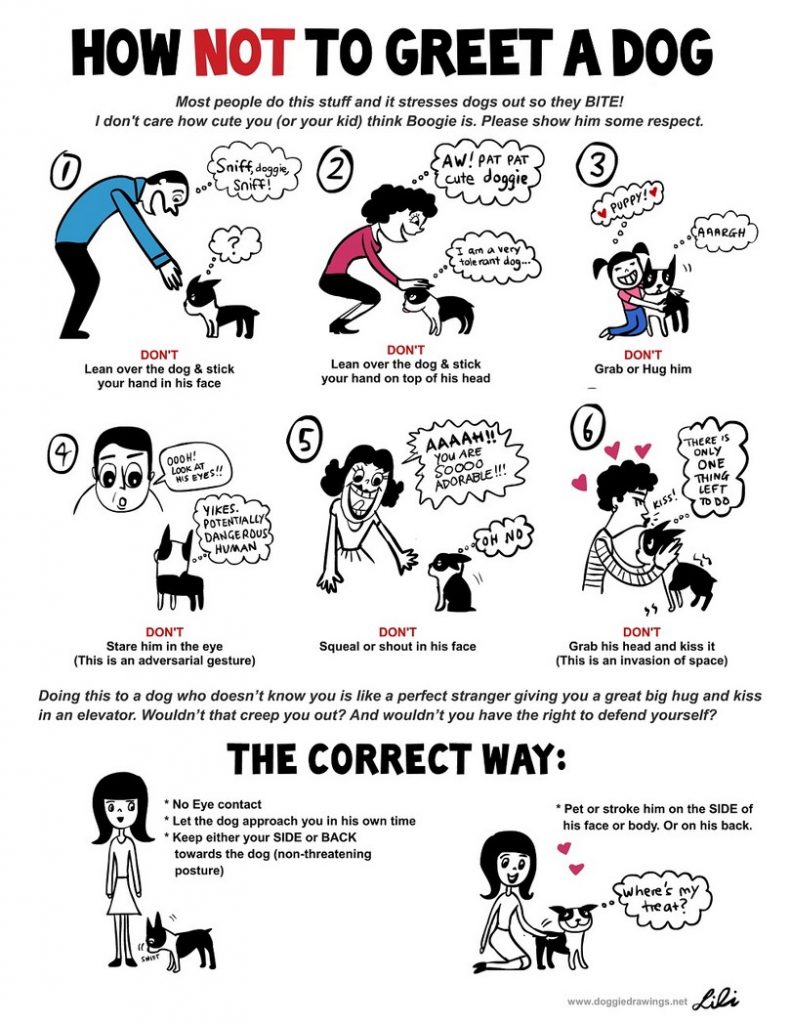
How To Greet A Dog

Contrary to popular belief, the best way to introduce yourself to a new dog is not by reaching out your hand for the dog to sniff. From a dog’s perspective, our hands are more like their mouths. Things humans do with their hands that dogs do with their mouths: pick up objects, use them to eat our food, and sadly some dogs have experienced a hand hurt them. The BEST way to introduce yourself to a dog (especially a nervous one) is the “No Touch, No Talk, No Eye Contact” rule- let them come to you, don’t reach out to pet, avoid eye contact, and don’t talk to them. It’s also good to crouch down and get on the dog’s level while avoiding eye contact, so the dog feels more at ease approaching you to sniff. Only when they feel comfortable or even seem excited should you reach out to pet them. These tips aren’t just to keep people safe, but also to keep dogs safe! Most dog bites are caused by humans unknowingly provoking a dog to the point where that dog feels the need to protect themselves. And unfortunately, a lot of dog’s pay for the human’s mistake with their lives. No one wants that!

Scroll to Top